Organizations have never had more data. Dashboards track everything from customer acquisition and employee engagement to project delivery and financial performance. Reports arrive automatically. Insights are generated in real time. AI can summarize trends faster than ever before. And yet many organizations still struggle to make timely, confident decisions. If that sounds familiar, the issue may not be your data. It may be your decision design.
Swimming in Data, Starving for Clarity
For years, organizations have focused on improving access to information. The assumption was simple: if people had better data, they would make better decisions. In practice, that isn’t always what happens. Many leadership teams can point to situations where the data was available, the analysis was complete, and everyone agreed on the facts, yet the decision still stalled. The meeting ends and more information is requested. A follow-up meeting is scheduled and additional stakeholders are added. Weeks pass but nothing moves forward. The problem wasn’t a lack of visibility. The problem was that nobody had designed how the decision would actually be made.
Why Data Doesn’t Drive Action
One of the most common misconceptions in organizations is that visibility automatically creates alignment. It doesn’t. Two teams can look at the same dashboard and reach entirely different conclusions about what should happen next. A sales leader might see an opportunity to invest, while a finance leader might see a need to control spending, while an operations leader might see a capacity risk. The data is identical, but the interpretation is not. Without clear decision-making structures, more information often creates more debate, not more progress. In fact, additional data can become a substitute for decision-making itself. The pursuit of certainty turns into a delay tactic. Instead of reducing risk, organizations inadvertently increase it by slowing response times and allowing ambiguity to persist.
The Hidden Cost of Ambiguity
Most organizations measure operational efficiency. Few measure decision efficiency. Yet poor decision design creates significant hidden costs:
- Projects stall while waiting for approvals.
- Teams duplicate work because ownership is unclear.
- Leaders revisit the same issues repeatedly.
- Employees become frustrated by conflicting direction.
- Opportunities are lost while organizations search for perfect information.
When people describe their organization as bureaucratic, slow, or political, they’re often describing the symptoms of unclear decision structures. The issue may not be culture, it may be design.
What High-Performing Teams Do Differently
The most effective teams don’t simply invest in better reporting. Instead, they invest in clarity and they make intentional decisions about how decisions will be made.
They answer questions such as:
- Who owns the decision?
- Who provides input?
- What information is required?
- What level of certainty is “good enough”?
- When does discussion end and action begin?
- How will we know whether the decision was successful?
These questions sound simple, but they dramatically reduce friction because they replace uncertainty with accountability and they ensure that decisions can move forward without requiring endless consensus.
Designing for Decision Velocity
As organizations become more complex, decision speed becomes a competitive advantage. The organizations that adapt most effectively are rarely the ones with the largest datasets; they’re the ones that can convert information into action fastest. This requires intentional design – decision rights need to be defined, escalation paths need to be understood, and accountability needs to be visible. Most importantly, leaders need to create environments where progress is valued over perfection. A 90% decision made today is often more valuable than a 100% decision made six weeks from now.
The Role of Leaders
Leadership is often framed as setting vision, building culture, or developing talent. Those responsibilities matter, but leaders are also architects of decision systems. Every time a leader creates clarity about authority, accountability, priorities, or governance, they improve organizational performance. Every time a leader removes unnecessary approval layers, clarifies ownership, or establishes clear thresholds for action, they reduce friction. The result is not simply faster decisions, it’s better decisions that are consistent and made in a way that people understand and trust the outcome.
The Real Opportunity
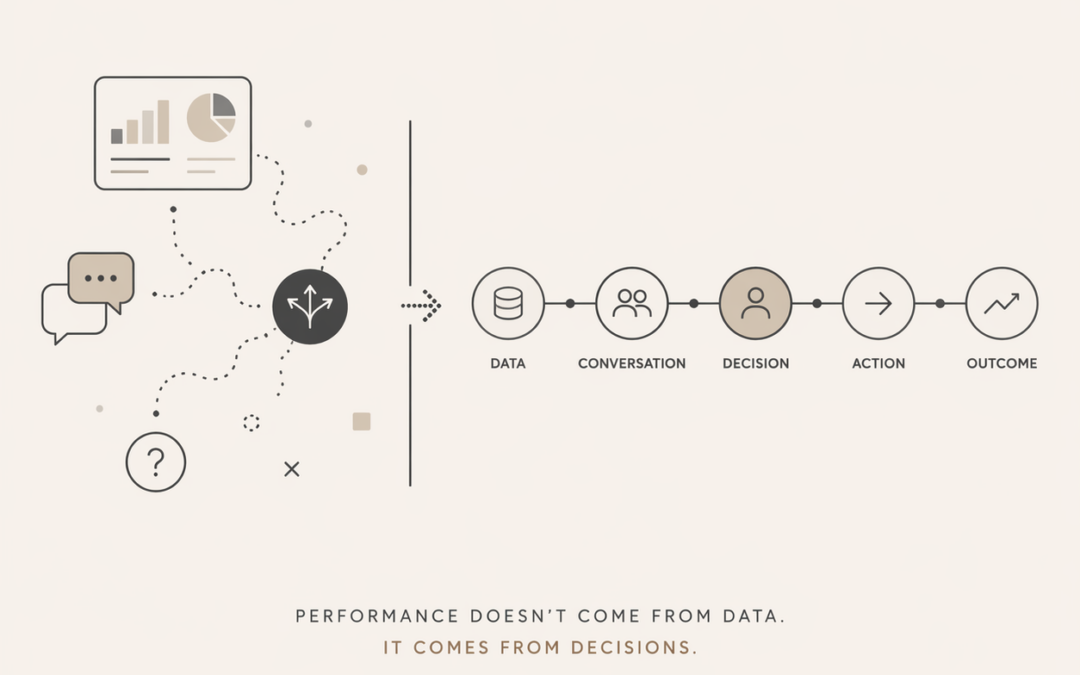
When organizations experience delayed decisions, conflicting priorities, or repeated debates, the instinct is often to assume there is a people problem. Maybe teams need more training or communication needs to improve. Maybe leaders need more information; sometimes those things are true. But often the bigger issue is that the organization has never deliberately designed its decision-making processes. Performance rarely breaks down because people lack dashboards. It breaks down because the pathway from information to action is unclear. The organizations that thrive in the age of AI and analytics will not be the ones that accumulate the most data. They will be the ones that design the clearest path from data to decisions, and from decisions to action. Because performance doesn’t come from data – it comes from decisions.