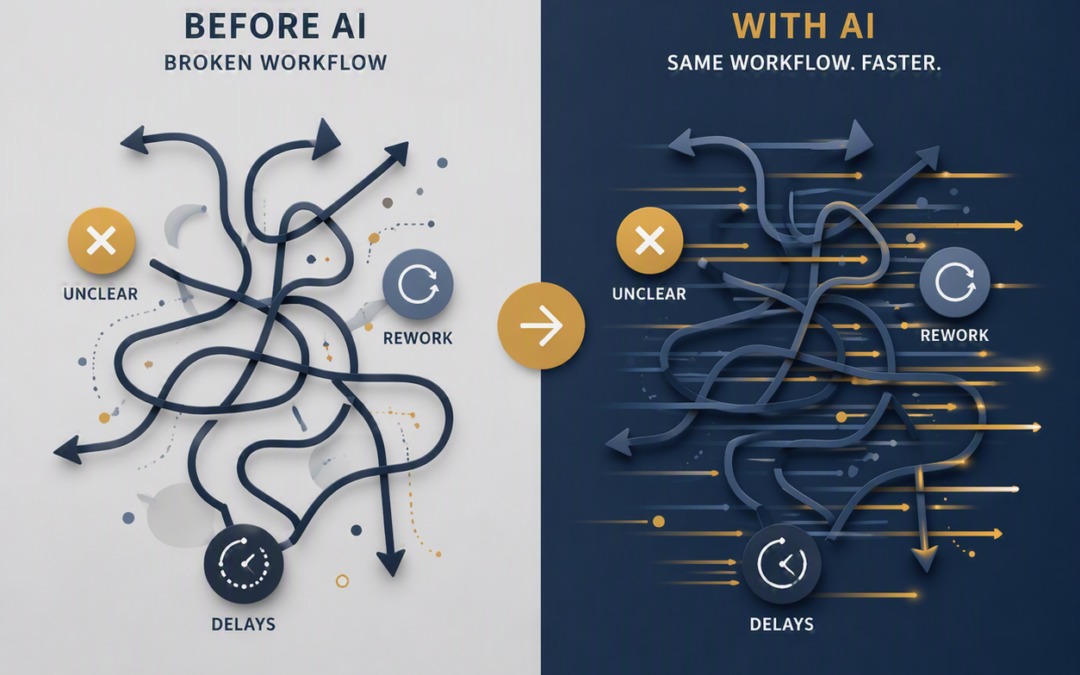
There’s a growing belief that AI will solve operational problems. AI won’t fix broken workflows, it will scale them.
The Hidden Risk of Moving Too Fast
Many teams are already operating with friction baked into how work gets done. You see it in:
- unclear or inconsistent processes
- constant rework
- decisions that feel disconnected from reality
These issues aren’t new; they’ve just been tolerated. Now AI enters the picture and the instinct is understandable: “Let’s automate. Let’s move faster. Let’s improve efficiency.”
But if the underlying system is unclear, AI doesn’t fix it. It accelerates it.
Faster Doesn’t Mean Better
When you layer AI onto a messy workflow, three things typically happen:
- Unclear processes become faster unclear processes
The ambiguity doesn’t disappear. It spreads. - Rework happens at greater speed and scale
Instead of fixing issues upstream, you multiply them downstream. - Disconnected decisions compound
AI can optimize within a system—but it can’t correct a system that lacks alignment.
The result is more output, more activity, but not necessarily more value.
The Question Most Teams Are Skipping
Organizations often start with: “Where can we use AI?”
But that’s not the most important question. The better question is: “Do we actually understand how work happens today?”
- Where does work slow down?
- Where does it loop back?
- Where do decisions get made—and by whom?
- Where does effort get duplicated?
Without that clarity, automation is guesswork and scaled guesswork is expensive.
Clarity Before Automation
Before introducing AI, teams need to do something less exciting—but far more valuable:
Make the work visible. Understand how work flows end-to-end, where friction exists, what decisions drive outcomes, and which steps actually add value. Only then does automation become powerful because at that point, you’re not just moving faster, you’re moving in the right direction.
A Simple Test
Before you invest in another AI initiative, ask these three questions:
- Can we clearly describe how this work happens today?
- Do we agree on where the problems are?
- Are we fixing the system or just speeding it up?
If the answers aren’t clear, the priority isn’t AI; it’s understanding your workflow.
The Bottom Line
AI is a force multiplier. It will amplify whatever system you already have and good systems get better. But broken systems break faster so clarity before automation. Always.